
Solid Zinc vs. Sheet Zinc: What’s the Difference, and Does It Matter?
I’ve been in this business for more than 20 years, and the question I hear most isn’t “how much?” It’s “aren’t all zinc tops the same?” The short answer is no. All zinc products are not created equally. Two tops can look alike on the showroom floor and live completely different lives once they’re in a busy bar, a hotel lobby or a restaurant patio.
So let’s put the two most common ways of building a zinc top side by side: wrapped sheet zinc and a solid zinc surface. No sales pitch. Just what each one is, where it shines, and where it struggles.
What is a sheet zinc top?
A sheet zinc top starts as a flat sheet of zinc, about 0.7–1.0 mm (about 0.03–0.04”) thick, which is typical of wrapped tabletops. The sheet is cut, bent and folded around a core, usually plywood, MDF or a similar wood panel. The corners are folded and soldered or tucked, and the sheet gets glued down to the core.
It’s the traditional American method, and it’s been around since the years after WWII. Done well, it looks great. It’s also the method behind most DIY zinc projects. If you want to try it yourself on a small, square tabletop, I wrote a whole guide on DIY zinc countertops.
Where sheet works well:
- Simple shapes: squares, rectangles, straight runs.
- Square or simple edges.
- Indoor, mostly dry spots.
- Smaller budgets, and the DIY-curious.
Where sheet struggles:
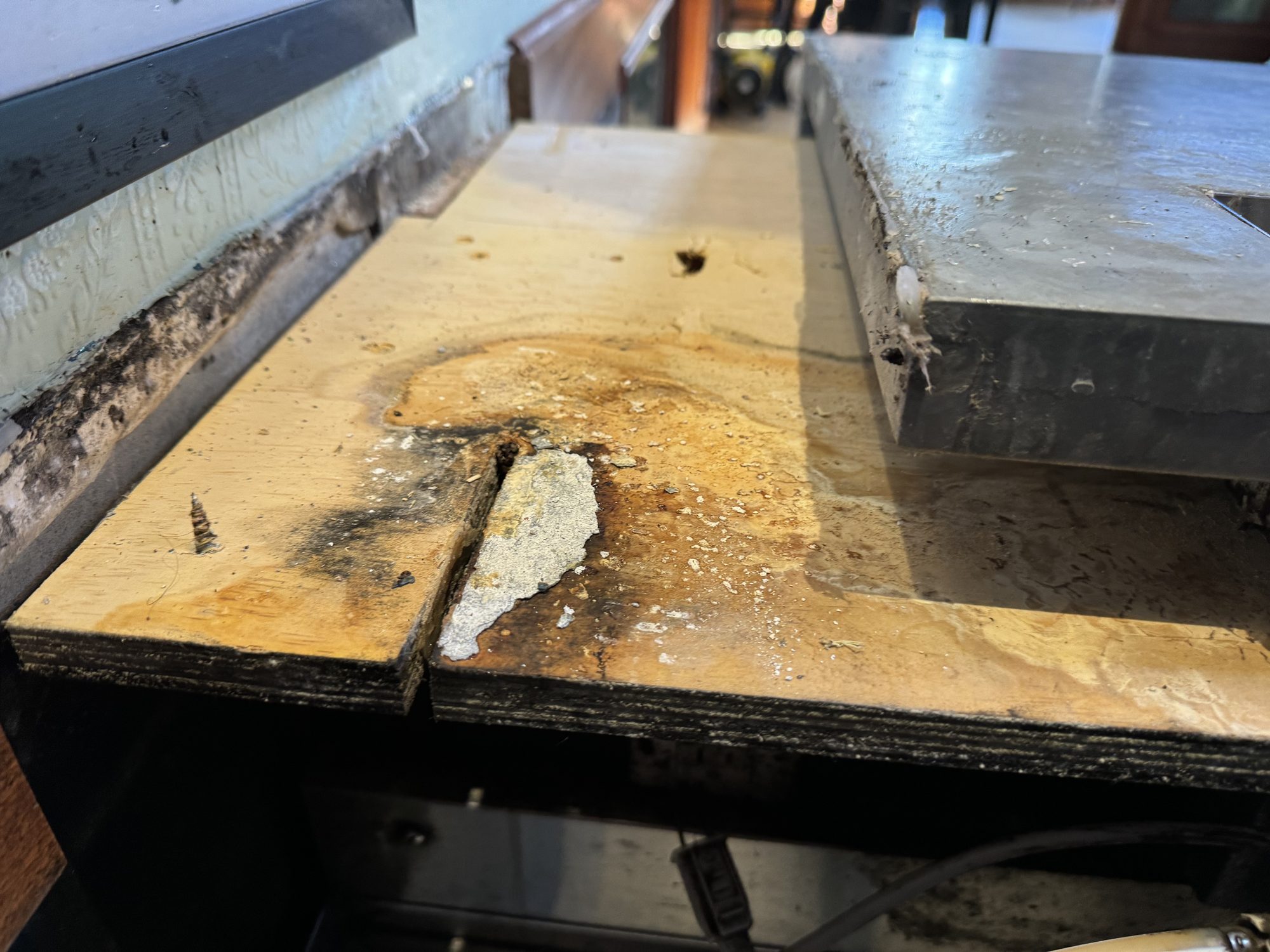
- Shapes. Flat sheet bends in straight lines. Compound curves, serpentine bars and sculpted edges are very hard or impossible to wrap cleanly.
- Seams. A sheet only comes so wide and so long, so bigger tops need seams, and every corner is a fold or a joint. Underneath, the wood core is usually glued up from panels too: a typical 12–16 ft wood-core top has internal joints about every 8 ft.
- Water. The metal doesn’t mind water. The wood core underneath does. Water finds a corner or a seam, the core swells, and the metal gets pushed out of shape from inside. I’ve replaced bars where the zinc looked fine and the core under it had rotted.
- Thin metal. At 0.7–1.0 mm (about 0.03–0.04”), a hard knock leaves a dent, and there’s not much metal to work with when you refinish.
What is a solid zinc surface?
Our tops are built differently. Instead of folding a thin sheet around wood, we make a solid zinc surface, not sheet metal, over a waterproof core. Our flat tops use a waterproof composite, and deep edge builds handle the large edge profiles:
- No internal seams. Our tops aren’t glued up from wood or plywood pieces, and there are no folded corners or soldered joints on the surface.
- 2–3× the thickness of the 0.7–1.0 mm (about 0.03–0.04”) sheet typical of wrapped tabletops.
- Rated indoor and outdoor, because there’s no wood inside to swell.
- Any shape at no upcharge. Curves, radius corners, bullnose edges, waterfall ends, ogee and beaded profiles.

It’s still real zinc you can touch. We use high-grade zinc that is 99.9%+ pure and made in the USA, and material certifications come with every order. It has the same living finish as any zinc bar in Paris: bright when new, settling into a soft blue-gray with use.
Side by side
| Wrapped sheet zinc | Solid zinc surface (3 Spark) | |
|---|---|---|
| Metal thickness | Typically 0.7–1.0 mm (about 0.03–0.04”) | 2–3× that |
| Seams | Folds and soldered corners. Larger tops need seams across the surface, and wood cores have internal joints | No internal seams. Long tops are made in sections up to 10 ft |
| Core | Usually plywood or MDF | Waterproof core (a waterproof composite on flat tops, or a deep edge build) |
| Shapes and edges | Straight lines and simple edges | Any shape and any edge, at no upcharge |
| Outdoor use | Usually limited | Rated indoor and outdoor |
| Patina | Living finish | Living finish |
| Best for | Simple, square, indoor tops, DIY | Commercial bars, counters, curved and outdoor work |
“Does thickness really matter?”
It matters more than people think, in three ways.
Dents. A thicker skin spreads a hard knock instead of printing it. Zinc is a soft metal either way, so a dropped cocktail shaker will still leave a mark on any zinc top. Thicker metal just shrugs off more of the everyday knocks.
Refinishing. Once a year or so, a lot of owners give their tops a light scuff and a fresh coat of wax to even out the patina. With more metal on the surface, there’s more room to do that over the life of the top.
Edges. The edge is where hands, hips and bar stools hit, and on a wrapped top it’s the thinnest part, because the sheet is stretched around a bend. A solid surface keeps full thickness around the edge profile.
“What about outdoors?”
Zinc itself loves the outdoors. It’s been on European roofs for 200 years. The problem with most zinc tops outside isn’t the zinc; it’s the wood core. Rain, sprinklers and humidity get into the seams and corners, and the core swells.
Because our core is waterproof and there are no internal seams, our tops are rated for indoor and outdoor use: restaurant patios, rooftop bars, pool decks, outdoor kitchens. Outside, zinc patinates faster and more evenly, and honestly it looks better for it. More in outdoor zinc bar tops, outdoor countertops and the AguaFuego outdoor collection.
“Is a solid zinc top heavy?”
Usually the opposite. Our tops are up to 40% lighter than others. On a long bar run that’s the difference between a two-person crew and a crane strap.
“Do they patina the same?”
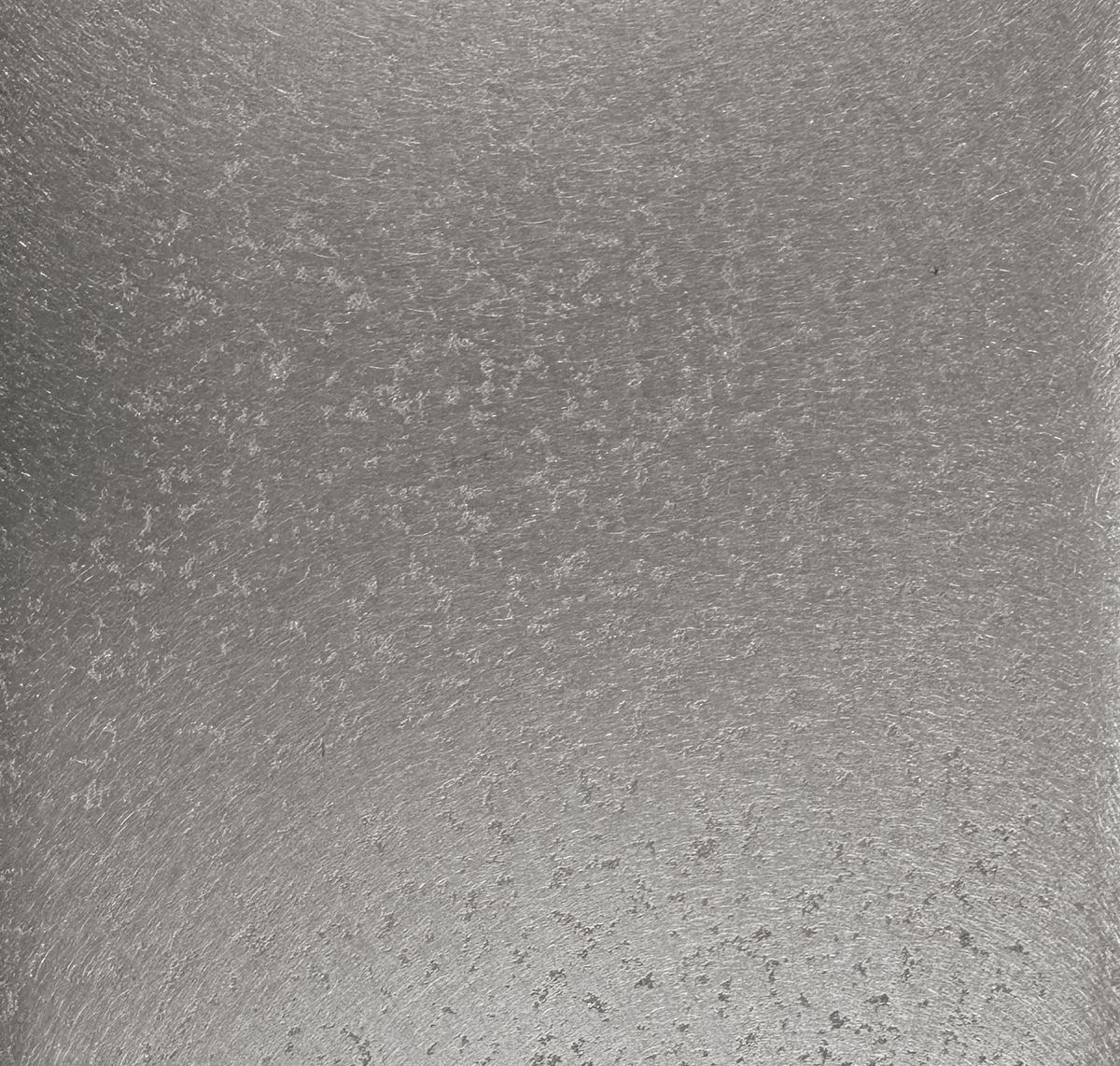
Yes. It’s the same metal, so you get the same living finish: fingerprints, water rings and lemon wedges at first, blending into an even, lived-in look over weeks and months. You can let it go, wax it to slow it down, or lighten it back up. Either way, you end up with a beautiful top. More on that in Zinc patina: how zinc countertops age.
“So which one should I choose?”
Here’s my honest take.
Choose wrapped sheet zinc if:
- the top is small, square and indoors
- it won’t see standing water
- you’re on a tight budget, or you want to build it yourself
Choose a solid zinc surface if:
- it’s a commercial bar, café counter, reception desk or restaurant table that will take real traffic
- the shape has curves, radius corners or a sculpted edge
- it’s going outside, or near a bar sink, coffee station or dish area
- you want the top to last and still be repairable years from now
Whichever way you go, ask the right questions:
- How thick is the metal, in millimeters or inches?
- What’s the core made of, and what happens if it gets wet?
- Where are the seams?
- Can I see a real sample?
A good maker will answer all four without blinking. For kitchens and hospitality counters, see zinc countertops.
FAQ
Is a solid zinc surface the same as a solid block of zinc?
No. A top made entirely of zinc would be extremely heavy and impractical. Ours is a solid zinc surface, real metal everywhere you touch it, over a waterproof core.
How thick is sheet zinc on a typical wrapped top?
About 0.7–1.0 mm (about 0.03–0.04”), which is typical of wrapped tabletops. Our solid zinc surface is 2–3× that.
Does a solid zinc top have any seams at all?
There are no internal seams. Our tops aren’t glued up from wood or plywood pieces, while a typical 12–16 ft wood-core top has internal joints about every 8 ft. Long tops are made in sections up to 10 feet, with no internal seams within a section. We plan where sections meet with you on the shop drawing.
Can sheet zinc tops go outdoors?
Some can, with care, but the wood or MDF core is the weak point when it gets wet. Ours are rated indoor and outdoor because the core is waterproof.
Is zinc OK around hot pans?
Use trivets under hot pans, pitchers and serving dishes.
Do you also make brass and copper tops?
Yes: brass and copper, as well as zinc, each with its own color and patina. Bronze may be possible on request.
What warranty do you offer?
A Limited One-Year Warranty. Details are on our Resources page.
How do I get a quote?
Send a sketch or drawings and book a 15-minute call.